Not With a Bang, But a Whimper
After two years, Hugo House needs a new executive director. Again.
Kelly O
HUGO HOUSE No one’s talking.
Tools
"I'm Lyall Bush, programs and education manager and soon to be executive director of Hugo House." This was as much of an announcement as was ever offered to the public when Lyall Bush took his new job at Richard Hugo House, and it was offered almost offhandedly in the course of introducing Matthew Stadler at a reading. Christopher Frizzelle, in a February 2006 edition of The Stranger, commented that Bush was almost "shy" about the announcement, which was "slipped in sideways... like it isn't big news."
If that announcement was painfully understated, Bush's departure from Hugo House is even more so: On September 11, rumors of Bush and Hugo House parting ways spread through Seattle's literary community with the speed usually reserved for an apocalyptic plague outbreak in a thriller. The Stranger sent e-mails to Hugo House and promptly received confirmation from Brian McGuigan, Hugo House's program associate: "Yes, it's true; Lyall is no longer the executive director of Hugo House."
Stranger Personals
Even murkier are the reasons behind the change. Six weeks ago, Bush took a sudden and unexpected leave of absence from his position, which Matt Carvalho, the president of Hugo House's board of trustees, described as "basically Hugo House's CEO." At the time of the leave, Bush was working with Wier Harman, the director of Town Hall, to put together a September 3 event starring Mike Daisey and Reggie Watts. Bush was supposed to introduce the pair, but Harman received a vague e-mail from Hugo House. "I was informed [Bush] was on leave and I was not told why," Harman says. "I just assumed he was dealing with a family problem." Harman was not told whether Bush would return in time for the event; he wound up introducing Daisey and Watts himself.
But Hugo House is currently shrouded under a mafialike code of omertà: Nobody is saying anything to anybody about Bush's departure. The silence has caused at least one major Seattle book critic—John Marshall, of the Seattle Post-Intelligencer, according to McGuigan—to carpet bomb Hugo House with petulant phone calls ("I'm going to find out why he left anyway, so you might as well tell me") and outraged e-mails. Speculation about Bush's departure is rampant and leaning toward the lurid, but Bush and the Hugo House board are restraining themselves to curt declarations of pride in past achievements and wishing each other well in future endeavors.
During that 2006 reading, Stadler announced Bush was "going to make something" of Hugo House that "we can't even imagine." The Bush years at Hugo House may not have been as mythical as all that, but there were some solid gains for the city. "Instead of this thing where you float in a famous author from South Africa like [J. M.] Coetzee to semi-insult Seattle audiences with his wisdom," Bush sniffed to Frizzelle, "what about Stacey Levine going up onstage with Aimee Bender? On a theme?" The Hugo House's readings series drastically improved, bringing authors such as Greil Marcus, Rick Moody, Michelle Tea, and Charles D'Ambrosio to town to read new work—Bush even placed on this paper's 2006 Genius Awards shortlist for improving the Hugo House's reading series.
But Bush also made embarrassing missteps at those readings. Bush would read his own work at those star-studded events, casting himself as an unbilled extra reader. At a March 23 reading titled "Answered Prayers and Other Tragedies," with a full complement of authors including Sherman Alexie, Tea, and Stranger writer David Schmader already scheduled to perform, Bush read for 15 minutes to an impatient crowd about how "answered prayers" were like "warm doughnuts."
"Lyall certainly has his own style," Carvalho says in reference to Bush choosing to read his own work before other readers, "and I'd expect his replacement to do things differently."
Hugo House under Bush's leadership looks drastically different from the Hugo House of his predecessor, cofounder Frances McCue. Matt Briggs, who was a Hugo House writer in residence during the beginning of Bush's tenure, says: "Lyall pretty much tossed out a lot of the fuzzy social, community activism, and accessibility stuff and began to put in place a more standard, programmed literary structure." Ron Starr, on his blog Library of Babel, claims that the poets at Floating Bridge Press and The Raven Chronicles were railroaded out of Hugo House for more profitable tenants. Starr blames Bush.
Around the same time, Hugo House ended its support of the experimental SubText reading series, which relocated to Wallingford, and closed its Books to Prisoners program.
Briggs critiques Bush for changing Hugo House from "a community-owned organization" to "a corporate enterprise that gave merit-based gifts... I remember him telling me he wanted to make it more in the image of Seattle Arts & Lectures. Local writers need another Seattle Arts & Lectures about as much as we need another Barnes & Noble." Briggs has his suspicions about what happened: "The fact that [Bush] left without a party means he isn't leaving because he wants to leave," he says.
Hugo House's 2008 to 2009 season—which includes appearances by
Bender, Alexie, Vikram Chandra, and Laura Veirs—has already been
planned; Carvhalo and McGuigan insist nothing about Bush's departure
will change those readings. Carvalho says an interim executive director
will be announced "in the next two weeks," and McGuigan says that Hugo
House will then embark on "a national search" for Bush's replacement.
![]()
Write your own damned review.
Thanks. Matt Carvalho
Phoebe Bosche
Raven Chronicles
I participated in the Jon Nelson Program and would do so again if asked. I'd hand our circulars for the program or whatever was necessary. I think it is a necessary program, civil, and I'm glad it exists.
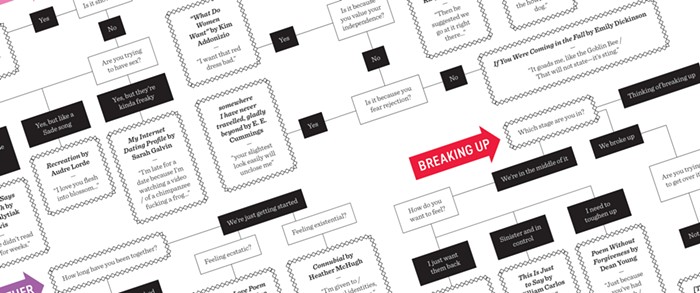
I find Matt Carvalho's expectations of an Executive Director curiously corporate. The word expectations summons to mind bullet lists of action items, road maps, and gant charts. (Although I like a good flowchart as much the next person.) Does he know what Seattle's expectations are of Hugo House? This is perhaps judged in the dollars and cents as these things are required to be of money raised, and money spent. If grants are good, expectations are met. I'm simplifying, but I doubt the board is measuring the number of sonnets being written or the number of zines being produced at Hugo House. In the last two years, I haven't been aware of any communication of expectations.
One of the incomplete aspects of Frances McCue's tenure at Hugo House (but one those things that seemed really exciting to me) is that she often seemed to want to hear what Seattle (or whatever/whoever would provide noise) expected from Hugo House. One of the aspects of fuzziness about the institution is that the house seemed to want to retain its lack of definition, its openness to accident, and expectations from anyone who cared to take part in ownership of the house. Maybe that is a Utopian idea. And doing stuff with Hugo House could be painfully circuitous, annoyingly communal, glacial. Many things came to complete dead ends. Often, while working there I was aware that it is communities that stone people to death.
Frances wrote about her efforts a while ago in what I think remains a hopeful idea for what an institution (and what Hugo House) could have been:
"Making Things and Making Things Better," published in the Community Arts Network.
I don't Frances McCue very well. But somewhere along the line in 2004 she would say after some open community forum or another, "What do writers really want?" She had gone from just listening to actually trying to find an answer it seemed. I think writers just want to be heard, really. They want someone to read their work. There are some paradoxical forces at work in this equation. More people want to write books, for instance, than read books. There are certainly more people writing blogs than reading blogs.
I'm not sure if their really is or should be an answer to the question "What do writers really want?" Or maybe it is a fuzzy answer. Maybe a Writing Resource Center should manufacture listening and comprehension? But, even this seems dangerous and to risk what is an essential aspect of the pliability or plasticity of a responsive organization. Once you get, an answer to "what do people want?" you are in business. You can set up shop, production, selling, marketing, cutting costs, and making some real money.
And then, the expectation from a board, I suppose, is to establish metrics around production or money raised. How good are ticket sales? Are they increasing? Are we reducing expenses? What is an acceptable loss?
I don't believe corporate logic applies to every institution. There are civic structures, such as libraries that cannot be profitable and in fact cannot be judged by an acceptable loss. Hugo House could have been a reverse library. I know that the community that showed up to help make Hugo House happen in the late 1990s and early 2000s had expectations of the place, and that the last two years have been a radical lowering of those expectations and collapse of their investments.
"(Although I like a good flowchart as much the next person.)"
Funny Stuff!
And later:
"Many things came to complete dead ends. Often, while working there I was aware that it is communities that stone people to death."
That kind of dark, sickly funny, and laugh-out-loud humour can be found in his books.
Hey, Hugo House Board: why don't you save all that money you would spend on a National Search for a new "E.O." or "CEO" (why are present HH Board Members talking like robots?), and just hire Matt Briggs?
Briggs, as much as I think you're a cool guy, your sniffing about "curiously corporate" expectations strikes me as curiously naive. I don't know about you, but when it comes to taking care of finances, keeping lights on, and being able to offer honoraria that don't make a mockery out of the joint, I want a fuckin' Excel spreadsheet wizard on my team.
As for what the community wants, can you really say with a straight face that everyone involved at Hugo House hasn't had an open-ears policy? And can you seriously be making the case that a Board of Directors be responsible for tabulating sonnets? Really?
You say "I don't believe corporate logic applies to every institution" and use by way of example a library. You're right, Matt. Libraries are supported by taxes, which the government compels us to pay. Hugo House, a nonprofit organization, depends on people giving it money out of the kindness of their hearts so that they can continue providing writing camps to teenagers and a space where novelists can work.
As for what people want, Matt, I can only speak for myself. You apparently speak for a larger community, a mourning coalition of folks who've had their expectations dashed. I'll tell you what I want. I want a place that hosts readings and events with talented writers from around the world. I want a place that offers classes on a wildly diverse array of subjects. I want a place that provides kids with opportunities to explore writing and literature. Do I expect everything that Hugo House offers to be my cup of tea? Hell no. I even expect to think that some of it sucks. Under Lyall Bush, HH took some risks, had some big wins, a few misses, but overall became an organization devoted to stripping pretense from the writing process and promoting the creation of new work.
By the way, can you point me in the direction of the source for your assertion that "More people want to write books, for instance, than read books." Huh. Interesting.
You say, "I'm not sure if their really is or should be an answer to the question "What do writers really want?" Or maybe it is a fuzzy answer."
No, it is neither a fuzzy question nor a fuzzy answer. I'd argue that your whole spiel is fuzzy, Matt. Give us some concrete examples of *exactly* what it is you'd like Hugo House to do. Share with us your proposals for workshops, events, community outreach programs. I wonder if the real reason for your post is that you enjoy the sound of your own complaining.
--Ryan Boudinot
And, obviously "Pheobe Bosche" is a friend of yours. God save Hugo House should their Board heed her reccomendation.
Why cant a writing center keep metrics on sonnets? It seems a better use for Excel than tracking donation dollars.
My view is relevant to the article because I was trying to clarify what I meant by fuzzy in the comments here and to say (again) the Books for Prisoners is a great program. But I've made it even fuzzier. Sorry.
Ryan, I also liked the way Paul Constant used "sniffing" as a subtle jib in the article.
I would like Hugo House to be a network, and provide organizational support to writers who are interested in writing. I would like Hugo House to provide Excel wizardry to people who can only use Word. I would like Hugo House to enable the productive capacities of the community rather than to offer workshops, events, and community outreach programs. Workshops, events, and community outreach programs limit the possibilities of Hugo House and have always conflicted with what I values as the central ethos of the place : to support writers doing essential work. (A clearly fuzzy mission statement that was changed around the time Lyall Bush first started working there.)
The way this would work:
A writer or lit events person wants to do something.
They go to Hugo House.
Hugo House says we can help you, yes you can do it, or no cant help you, but yes you can do it, heres how.
I am not enthused by the teaching of Creative Writing (as craft like wood carving) in this country. I'm not sure if these programs (as a graduate of one and participant in the racket myself) do anyone any good. I would say those aspects of Hugo House have always conflicted with its essential mission and muddied the waters.
81 percent of American adults says they would like to write a book one day. (1) Yet, only 45 percent of American have read a novel or collection of short stories in the last year. (2)
1) http://query.nytimes.com/gst/fullpage.html?res=9B0CE4DE1638F93BA1575AC0A9649C8B63
2) http://www.nea.gov/news/news04/ReadingAtRisk.Html
I do not believe that Hugo Houses board of directors or Lyall Bush had an open-ears policy. Open whatever strikes me as echoes the alarming corporate phrase open door policy where managers will openly listen the grievances of employees. Usually such a policy signifies the opposite, kind of like the phrase of some struggling parents, I take care of my kids.
Ryan, I cannot take this sentence, I wonder if the real reason for your post is that you enjoy the sound of your own complaining, in any other way except to mean shut up, and Im not about to shut up and I hope no one else does either.
I'd counter that Hugo House does allow the kind of interaction you envision, where writers can propose new programs and events. Was there an instance where you proposed something that was shot down? This reminds me of conversations I have about people who get frustrated by how their work isn't getting accepted in literary journals. My first bit of advice for them is to start their own journal, and very soon they will see how many pieces of writing--good ones--they have to turn down. HH has always struck me as an egalitarian place, albeit one with limited resources. In order to remain in existence, they have to say no to a lot of worthy ideas--and even more unworthy ones--simply to stay afloat. They have to keep the big picture in mind, which means they have to be strategic about what they agree to do. This means leaving certain good ideas on the cutting room floor.
As for your views on teaching creative writing, it being a "racket," etc, I couldn't disagree with you more. Writing classes and workshops were at times the only things that made my education bearable, and now I'm delighted to be teaching in an MFA program. You have your impression about writing education, I have mine. But I will say, why keep teaching if you think it's such a sham?
It's hard to take your statistical argument seriously, because you quote two separate sources for your data. One is an unnamed "recent survey" quoted in the New York Times, the other is a survey funded by the NEA. Without knowing the sample sizes or methodology of these surveys, it's tenuous at best to draw the conclusion that more people want to write books than read them.
As for the receptivity of Lyall and the rest of the Hugo House administration, I can only support my argument by saying that I've been dropping by the place off and on for the last year, and every one of those folks seems to have five minutes to spare for me. I was batting around ideas for a new program with Lyall just a few weeks ago, in fact.
I really hope that you find some resolution over what's eating you about HH. Or start your own organization that can provide the resources you think the literary community of Seattle needs. Let me know if you do. I'd be happy to make a donation.
Ryan Boudinot
I concede that my sources -- Jason Epstein writing for the New York Times and the National Endowment For the Arts -- are probably flawed due to the vagaries of low-paid fact checkers and overworked analysts. We've all been there.
The details of our exchange have become too complex to deal with in the confines of a Web forum.
It has come down to this. You and me. The future of the Seattle writing community clearly, certainly, depends on us and our ideas about outreach programs at Richard Hugo House.
I concede, too, that perhaps a business minded approach is appropriate considering we are talking about an arts organization with a budget and employees and things.
In this spirit, I suggest we resolve our difference in the time honored traditional of all business minded people: dueling PowerPoint presentations outlining the potential futures of Richard Hugo House. In the yawning vacuum of Lyall Bush's mysterious departure, sense must be made, preferably in three word bullet points.
I suggest we meet in appropriate corporate or edgy marketing attire at a suitable location -- a whiteboard perhaps, an AV projector.
Go ahead present your vision of the future in a succinct, and sizzly deck.
I will also have a nice PowerPoint presentation prepared.
20 minutes each. 20 minutes to blow people's minds.
And then, the people can decide provided they are still awake.
Mr. Boudinot, author of The Littlest Hitler and soon to be released novel Egg and Sperm, I am calling you out. I challenge you to a PowerPoint-off. I demand this, or I demand your immediate concession to my generally sensible and cogent explanations and thoughts about the future of Richard Hugo House.
Name your time. Name you place. Check my Outlook calendar and schedule a rumble.
Thank You,
Matt Briggs
I regret your concession and defeat.
I hope you reconsider. There are many open source and non-Microsoft products to choose from for creating a presentation. I prefer (if this is your reservation). Myself, I prefer PowerPoint to all others.
http://slog.thestranger.com/2008/09/powerpointoff
Not the reasons at all why I declined. Best of luck to you and your future literary endeavors.
Peace,
Ryan
The very successful and worthy "Books To Prisoners" program (referred to as "books for prisoners") was originally sponsored by Left Bank Books, not the Subtext reading series. Also this program has not closed, i.e., please send donations! http://www.bookstoprisoners.net/News.htm
Fortunately or not, Subtext is more of a "prisoners of the book" sort of reading series. Which doesn't mean that we've stopped planning an escape from so-called prison house of language.
[end of letter to editor]
Frances should be commended for the aesthetic blank slate that (I thought) she tried to establish -- trying to make RHH a community meeting place for all sorts of writers/writing where things could happen.
That makes a lot more sense to me than trying to build an enterprise more focused on market values than aesthetic values. Though I guess the market can sort of become its own aesthetic.
On a personal note, I have been involved with Richard Hugo House, and considered Lyall to be my mentor and even a father figure, since I was fifteen. Lyall helped me get through high school and into the college of my choice, and was consistently an enormous source of support both personally and professionally. This article paints Lyall Bush as a failure (the title is borderline ridiculous) and disregards the fact that he has played a positive role in the lives of many, myself included. Lyall Bush is one of the smartest, kindest human beings that I have ever encountered. I wish him the best of luck in whatever he chooses to do next.
I think Hugo House has to know what it is before it can even begin to discuss what it wants to become. And what it is is a very small school with mediocre teachers advising bored suburban housewives. If it doesn't want to be this, then it should be something else. If it wants to be Seattle Arts & Lecture, then it should shut down and everyone apply for work over there. But first things first, I say
Nunya, you sound just like Matt Briggs and the other HH haters. Hugo is doing cool stuff and has a lot of cool people working there. You should hang out there more often and see what it's really all about before passing judgment. You clearly haven't been there in awhile.
I am not simply a HH hater. I was trying to get right to the silliness of their being just two sides to the issue with Ryan Boudinot when was categorically disagreeing with everything I said until were sounding immediately like two toddlers.
(Speaking of toddlers, I'd like to plug an upcoming dueling presentation of the future that I'll be doing with Doug Nufer. I will represent the hairy fairy hippie vision of possible Hugo House Futures. Doug Nufer will represent the hard minded, pragmatic businessperson's vision. I'm not sure where we'll do this yet, but I'll post it as soon as I know if you are all at interested. If not, don't look for it. End of plug.)
In the same way there is a weird suburban(bad)/urban(good) polarization that often happens it seems in Seattle arts conversations. it is odd to me that this is still the case since it seems to me that Matthew Stadler has done such an excellent and clear job of puncturing the myths that underlie this logic. Some of his work about this has even appeared in this paper.
http://www.thestranger.com/seattle/Content?oid=34043
I continue to have a stake in HH. It is clear to me that a lot of their people have their own way of thinking about also have their own sense of investment in the place. I think this is a good thing. It is exciting to see such a prolonged conversation. Someone asked above if I intended for my initial remarks to become personal. I don't know. Maybe I did? I had hoped even if I did that the conversation would drown me out, and it has more or less, I think.
Although apparently saying anything critical of HH places a person into the hater category, I wanted to point that my main issue with HH is that as a community writing center issues of access should be of primary concern. (To say the obvious, this is my opinion.) I've heard many personal stories both in the time I was a writer in residence there and afterward about individual writers having difficulty with HH around accessibility of the house. In fact during a fizzled community forum in 2003 or 4, this ended up being the main theme as far as I could tell among the people who showed up.
It sounds as if there are writers who had exactly the opposite experience during the same time frame. I think that is interesting and it would be interesting to know more about writers who have found benefit from the structure of the place.
A great deal of literary writing seems to me to foster a sense of learned-helpless in writers. Many writers depend on prizes, editorial acceptance in magazines and presses, certificates, book reviewers, and booksellers to validate their endeavor. For these writers, a writing resource center would constitute a way of supplying some of these things.
Personally I am less interested in a supply of these things. This is not to say I have never been concerned with them or that like many writers I don't spend more time than I probably should churning in a cycle of doubt, self-loathing, and megalomania that seems like it would be answered by the right prize, editorial acceptance, MFA or PHD program, review, or best selling book. Judging from the mental stability of some of our countries most lauded writers, I'm not sure if the cycle has a happy ending for writers.
I have found it more exciting to work with and watch and try to copywriters who just plow on ahead despite a supply of prizes, editorial acceptance in magazines and presses, or certificates. Seattle is full of writers such as Willie Smith, Marion Kimes, Jerome Gold, Clark Humphrey, the people who used to run the Zero Hour (Deran Ludd, Jim Jones, and Alice Wheeler) and the Northwest is full of these writers, people such as Dan Raphael, Charlie Potts, Paul Nelson, Kevin Sampsell, Rich Jensen, Polly Buckingham, Jim Munroe, etc)
Accessibility for this kind of writer is as simple as a word processor, a xerox machine, and a long arm stapler. And yet many of them have inadvertently benefited from the largess of Richard Hugo House. ZAPP actually had developed programming that supported this view of a writer. The DIY Academy was an excellent example of this and existed in the context of an organization that supported infrastructure style developments. Someone pointed out the Writer in Residence program seemed an example of this as well. I think so, too. However I had a fair share of people dropping in for their supply of validation. I didn't mind this. I said, "It's all right now," but some people didn't believe me even then.
I wonder can HH offer both a supply of prizes, editorial acceptance in magazines and presses, certificates, book reviewers, and book sellers and also support for essentially the writer who practically only needs a word processor, a xerox machine, and a long arm stapler? I believe this kind of writer needs some of the products of institutional organization such as distribution, visibility, discoverability, meeting room and conference space?
Often these two views of writers are seen as being odds. Lyall Bush, Alix Wilbur, and previous program directors at HH have had conversations with me where it was as much as said that these two visions of the house cannot in practicality co-exist. One program director actually did include a small press fair in an annual inquiry. ZAPP, too, suggests that it is possible.
He is a brilliant man and part of that comes from the fact that he is able to explain things to all people, from all walks of life so that they "get it"...
Whatever he did do, or didn't do, I think he deserves better than the innuendo that is being put up here.
He is a kind man who has dedictaed his life to make the arts accesible to all, young, old, black, white, latino etc.
Mr. Bush I you are the best teacher I ever had!
I give up. You win. Even though I enjoyed the Poetry Festival when it was at Hugo House, I had a table at the Small Press Fair, I like ZAPP and have my poetry zine down there, I featured at the first Cheap Wine & poetry and was just at their most recent one, an ex-girlfriend of mine taught some classes at the House, I guess I just don't get it and remain ignorant.
To knickersinatwist: I too am bored. Bored with thinking for myself.
So, you all make the Kool-Aid and I'll drink it.
Sincerely,
Nunya
October 18, 2006
LYALL BUSH
Lyall Bush has only had the job of executive director of Richard Hugo House for a few months, but already he's done smart things. He scraped the guts out of the annual inquirywhere, in the past, anyone could propose talks or games or miscellany on a subject, and the public bought (or didn't buy) ticketsand used all that money to commission new work from writers he likes. And he chose great writers, including Greil Marcus, Rebecca Brown, David Rakoff, Charles D'Ambrosio, Ryan Boudinot, Deb Caletti, Trisha Ready, and Stacey Levine. The organization used to be a collection of vague purposes; there's nothing vague about what Busha fine writer in his own rightis doing. He's using Hugo House's resources to bring great writing into the world. Matthew Stadler speculated at a reading earlier this year that Bush will turn Hugo House into "something we can't even imagine." CHRISTOPHER FRIZZELLE
The Stranger is the most incompetant half ass rag around!
And as for the delicious scandal we're nurturing:
It sounds like Mary M., above, might still be sipping her tea, or at least wanting to keep open the possibility of another cup. More power to ya Mary! -- I hope ya get another taste. I hope you're over 18.
Maybe John Marshall will hire a caricaturist to do a cartoon of the suave Mr. Bush, preferably with a goofy scarf around his neck, surrounded by his Hugo House Honeys.
Maybe there should be a "Rate Lyall Bush in Bed" Blog -- Kali, Tea, Mary ? Whadda ya say, Ladies?
Staying tuned--
I was not a "HH Honey" I was in an adult education class somewhere else when I met Mr. Bush. The friends I referred to were 1 female and two MALE...We all think the world of him. We loved his teaching style so much that when it ended we begged him to run a book group with us for a while after.
All of us came from backgrounds that made us wary and distrustful. Mr Bush never in anyway did anything to make us worried that our safety was in jeopordy. One of us was even a former sex worker who overcame her heroin addiction during the time we had class and she always felt valued by Mr. Bush not for her past but his belief in her intelligence and the potential of her future.
He reminded us all of who we are, not who we were.
If you have something to say, say it, instead of making vague slanderous comments. That is the problem here. The Stranger writes an article that reverses its former opinion of Mr. Bush and then states "facts" that are not substantiated in any way.
You come off as bitter and creepy and I am glad that you are no longer considering applying for that position. Funny how you won't even put your name down behind your comment.
I organized in Seattle on my own dime about 10 years ago - I hosted about 200 readings and participated in about 30 larger events (including the poetry festival which went on while the HH was under construction.) Ironically enough the one time I was accused of sexual harassment was probably the only time I didn't deserve it. Lyall -- if that is all that happened then congratulations are in order.
The HH has always struck me as tedious and corporate, however well intentioned and friendly. I have always liked the people involved, but never had much respect for the organization.
If you want to do something for writers, become a better reader.
The point when the legal system can plausibly be introduced to the sexual relationships between the adult members of an arts organization, I think, is probably exactly when that organization has gotten too big and should sell it's office supplies on ebay and fold up shop.
Being an artist has always been about being a human being for me, and being a human being has a lot to do with being a monkey.
Ryan Boudinot -- you are a fine exemplar of why I will not ever take a creative writing class.
James D. Newman
I wonder if this 'public dialogue' has gone past the point of being good for anyone, and into the arena of being potentially very destructive for Lyall, Hugo House, and other individuals who are not public figures but are trying to go on with their lives.
I hope that the editors of the Stranger will close this article for comments.
The problem is one of taking oneself too seriously -- it needs to be aired because it is choking the Seattle Arts community.
Morbid self seriousness is the great failing of almost every arts organization I have worked with for the last 12 years -- and it has been a few.
The solution is breathing, laughing (at ourselves and each other) and not patronizing organizations that feel creepy and stiff and vaguely like East Coast Social Science departments.
More freedom, fewer mission statements.
It's so sensible, what you say about how we shouldn't patronize institutions we don't like. Also, thank you, and everyone else on this thread who is using your full name, for doing so.
It is true that the international small arms trade is more horrifying than this conversation. I do not dispute it.
And perhaps arts organizations take themselves too seriously, I have no expertise in this area.
But I am not an arts organization, I am a private individual, and this conversation does not feel silly or laughable to me.
It is laden with anonymous invective, contempt, and character assassinations; weapons that to my ear sound more characteristic of the Karl Rove arsenal than of an effort at clearing the airways of the Seattle Arts community.
Many of the comments are cruel, crafted to inflict suffering, and most of those anonymously so.
I think words are powerful, and can damage real living beings, when they are used with aggression and the intent to harm, humiliate, or silence others.
I think we must make a real effort to talk to one another with gentleness, respect, and dignity, even when we have not been spoken to that way ourselves, even when we don't feel like it.
Thanks for allowing me to say that.
Jan


RSS
Comments (54) RSS