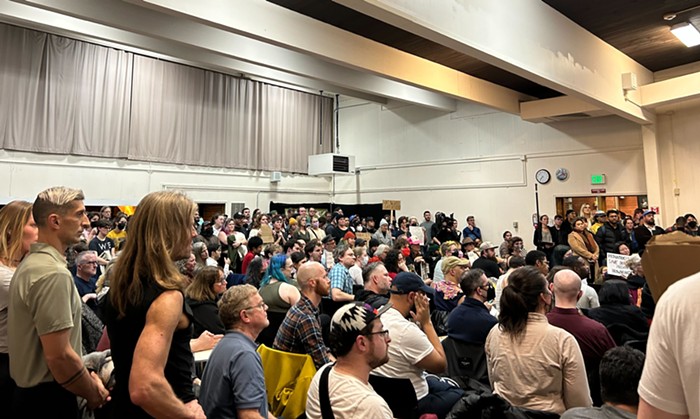
Seattle's Catholics are angry—at other Catholics. Their ostensible leader, Seattle Archbishop J. Peter Sartain, has spent the last three months crusading to stop same-sex marriage from becoming state law and, even more controversially, is now leading a pope-mandated inquisition against thousands of American nuns for adopting "radical feminist themes." Finding themselves at ground zero of a national fight with implications for millions of secularists, Catholics here have held weekly vigils near the archbishop's office, filed a political action committee to counter his views on marriage equality, and even begun cutting off money.
"I didn't give anything this year," says Roger Yockey, a parishioner of St. Patrick on Capitol Hill, referring to the church hierarchy's annual springtime collection. That's because donations from people like Yockey ultimately help fund the United States Conference of Catholic Bishops, of which Sartain is a member. That group has surged in recent years to become one of the most politically emboldened religious entities in the nation, and at the same time, its agenda has swerved hard to the right to focus on banning contraception and opposing gay marriage rights—not just in Washington, but in other states including California, Maine, and Minnesota. For people like Yockey, watching Sartain go after America's nuns was the final straw.
"The average age of American nuns is 74 years old," Gretchen Gundrum, who used to be a sister, told me last week. "These women have given their whole life to the service of the church, with no salaries and following the gospel. They are being told at the end of their lives that they are not being faithful and that they have been bad girls. They are treating these mature women like they are little kids. It shocks laypeople like me."
Yockey and Gundrum were two of more than 150 local Catholics at a recent vigil on the steps of St. James Cathedral in Seattle's First Hill neighborhood to defend the sisters, one of two-dozen vigils across the country. However, the events in Seattle may have a particular impact on a bishop whose chancery office is just one block away. While protesting is one means to capture Sartain's attention, Yockey said, "The bishops will get this message when the collection plates have less money in them." And he is hardly alone in that thinking.
Several Catholics have told me in the past two months they would maintain donations to parishes and Catholic charities, but not to the bishops. Betty Hill, who organized Seattle's weekly "I Stand with the Sisters" vigils, says she's stopped giving to the annual Catholic appeal entirely due to the bishop's aggressive political agenda and she "expects other people to withhold some giving."
"I think they are covering up for their own sins, sexual abuse," Hill says of the crusade to scrutinize the nuns. "The bishops have lost their moral authority and they want it back. But Archbishop Sartain needs to be aware that we are going to support the sisters, probably over him."
This clash also sets up a strange irony: Even though Seattle is notorious as one of the least churched cities in the nation, it's now at the epicenter of a clash inside the world's most powerful church.
The latest fissure results from a decree in Rome. The Vatican last month found that the Leadership Conference of Women Religious, which represents 80 percent of nuns and sisters in the United States, has taken positions that "disagree with or challenge positions taken by the Bishops, who are the Church's authentic teachers of faith and morals." These women of faith had been focusing too much on alleviating poverty while remaining "silent" on abortion, death with dignity, and gay marriage, according to the April report. Now Sartain has begun a five-year campaign to rewrite the nuns' policies and force them to capitulate to the church's right-wing agenda.
Several sisters, including those on the national board, declined to make a statement on the matter until they convene this week to consider their options. Gundrum, however, says she expects a statement as soon as this weekend. The sisters could decide on action as radical as disbanding or could choose the route of complete cooperation—but the latter seems unlikely.
Gundrum adds that "the only power we have as laity is the power of the purse" to withhold donations.
But do the growing protests have any hope of dialing back the church's agenda in the United States?
"I hope they do," says Father John Whitney, the priest at St. Joseph Parish, and one of several priests to join the growing ranks of local Catholics opposing Archbishop Sartain's agenda. (Whitney prohibited petitions to repeal Washington State's gay marriage law at his church, even though Archbishop Sartain invited petitioners inside all the local parishes.) Whitney also hopes church higher-ups will decide on their own to "rethink their intervention and rethink their takeover of the Women Religious."
But realistically, if there is to be a reining in of the headstrong hierarchy, Whitney says it's unlikely to be done by the hierarchy itself, and it's unlikely to result from the outrage of the general, non-Catholic public. Nor is it with people like me who were raised Catholic, got frustrated, and left the church. The change, he believes, will result from those people who are staying inside the church, who attend mass every week, who are priests, and who tenaciously defend their reading of the gospel as a charter to help the impoverished instead of terrorizing women and gays. The Catholics can withhold their money, lay claim to the cathedral steps, stand at the pulpit, and resist from the inside. And secular progressives better hope they don't give up.
"I think that if American Catholics speak with one voice, I don't know how the hierarchy can't listen," Whitney says.