Marie Antoinette's critics, toward the end of her life, didn't just call her rich and clueless—they hissed that she was an Austrian lesbian slut. In particular, they accused her of carrying on with Gabrielle, the Duchess of Polignac. So French author Chantal Thomas wrote her historical novel, Farewell, My Queen, as a portrait that amounts to a retort (retortrait!). The book came out in 2002, and it detailed the four days that began with the storming of the Bastille, telling the story from the perspective of a young female servant smitten with the queen, while the queen is deeply in love with Gabrielle. Ten years hence, the novel has been adapted into a movie, and it's a big-screen depiction in which lesbianism is the rule, nothing out of the ordinary—a satisfying twist on a virulent form of real-life persecution that still persists.
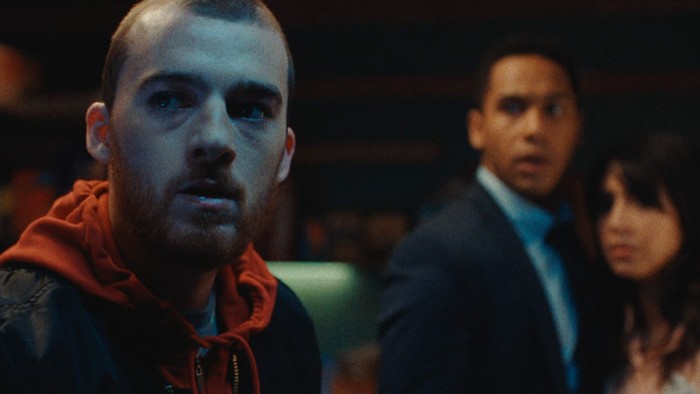
The story of the movie feels slightly distant, but the setting and the characters are uncharacteristically warm and close for a period piece. It's a pleasure to find such a short bridge to the past. As for loyalties (this is a revolutionary picture, after all), director Benoît Jacquot is no royalist—he insists on multiple shots of the rats that infested the hungry country—but his depiction of the queen is far from caricature. If Sofia Coppola's queen was foremost a creature of style, a sweaty prop on an overheated stage, Jacquot's/Thomas's is an actual woman, sometimes self-pitying and unlikable, but as often sympathetic and almost noble. None of the actors is a mannequin for period costume; a blurry, Rembrandtish realism radiates from Farewell, My Queen, especially out of nighttime scenes of Versailles's poorly lit hallways.
Jacquot's direction is fine-grained. In a rush to see the queen, the servant girl trips, falls, gets up, looks around to see who has witnessed her. The sequence takes time, but establishes the sense of surveillance and heavy propriety that overhang the court. In another scene, Gabrielle bursts forth from a crowd and walks forward to embrace her queen in a moment of need. The two spend a silent minute forehead to forehead before they disappear through a door at the back of the mirrored hall, and the camera sits perfectly still the whole time, like the onlookers, stunned by the lovely, daring intimacy.
The movie is packed with standout performances from actresses: Léa Seydoux as the never-servile servant, Noémie Lvovsky as her nervous and wise (and wisely nervous) boss, Virginie Ledoyen as tough Gabrielle, and Diane Kruger as the doomed queen. (In real life, Kruger is a German speaker living in France whose mother's name happens to be the same as Marie Antoinette's; the empathy is flowing.)
Don't expect revolutionary action. This is a domestic film, even given that this household is largely populated by a staff. The employees occupy plain rooms, only moonlighting in brocaded bedchambers and sparkling dance halls. Their plebeian huddles are more interesting than the decisions of the desperate king and queen. When it comes, the climactic scene is as atypical as the rest—it involves a green dress, a threesome, the Revolutionary Army, and the small sound of a woman's voice.