dir. Tom McCarthy
Opens Fri Oct 17
at the Egyptian.
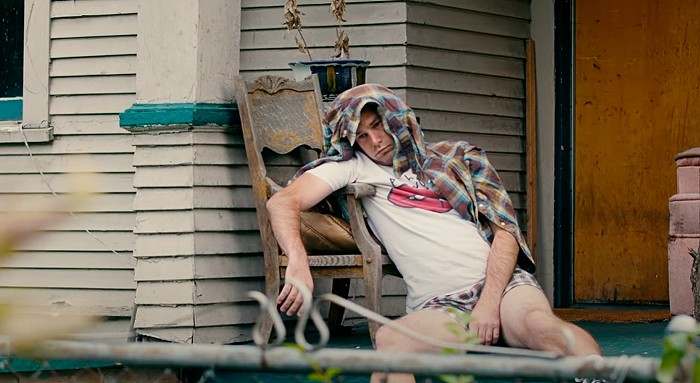
In Living in Oblivion, Peter Dinklage plays the surly dwarf who complains that any dream sequence featuring a dwarf is nothing more than an art-film cliché ("I don't even have dreams with dwarves in them!"). His frustration is funny because what he has to say is true. He carries a similar--though quieter--sense of honesty into his starring role in The Station Agent. Dinklage plays Finbar McBride, a train aficionado who inherits an abandoned depot. The remote location suits him fine because he's not the most social of people. That doesn't stop the nearby Cuban hot dog vendor Joe (Bobby Cannavale) from talking to him, nor does it stop the woman who almost runs him over (Patricia Clarkson) from stopping by for an apologetic drink or several. They befriend him despite his better efforts to brush them off.
Dinklage is positively magnetic here, and I hope it leads to more starring roles for him. Clarkson overplays her character's clumsiness early on, and she's saddled with the most "dramatic" backstory, but by the time the second half of the film kicks in, so does her performance. The biggest surprise is Cannavale. He takes a role that could easily have been obnoxious and overbearing and makes a likable human being out of it.
What McCarthy has captured in his debut feature is a sense of happy loneliness--those times when it feels right to go for a walk and just look around and not talk to anyone. But it's also about how that can be a trap, and how sometimes you need people to goof off with. I hope that in inhabiting this role, Dinklage lands more leading-man parts. At the same time, I hope Bobby Cannavale gets lots more roles in general. ANDY SPLETZER
Wonderland
dir. James Cox
Opens Fri Oct 17
at various theaters.
For all the faults to be found in Paul Thomas Anderson's Boogie Nights (and there are definitely many), two scenes are above reproach: the firecracker scene and the very final scene. The firecracker scene was a brilliantly constructed, exceptionally tense downfall for the film's main characters, placing the audience in the same absurd scenario as Dirk Diggler and Reed Rothchild; it seemed to perfectly sum up the type of disaster that one expects porn stars to encounter during a spiral downward. The final scene, in which Dirk Diggler finally shows off his giant cock for the audience (with the opening strains of ELO's "Livin' Thing" playing), was the film's perfect ending--a glimpse of the one element that made Dirk Diggler stand out as a being, an element kept hidden from view for the bulk of the film's running time.
Wonderland, directed by James Cox, takes as its plot the Wonderland murders of 1981, in which four people were beaten to death with a lead pipe in a Laurel Canyon apartment--a drug-inspired murder that (along with Robert Downey Sr.'s Putney Swope) influenced the firecracker scene in Boogie Nights. One of the key characters in the Wonderland murders was John Holmes (inspiration for Dirk Diggler), who was entangled with both groups involved in the slaughter. At the time of the killings, Holmes (played here by Val Kilmer, though he appears to be playing Jim Morrison yet again) was on the downslope of his career, engulfed in cocaine and unable to find work. His possible involvement in the murders, either as a witness or a participant, made the Wonderland killings a media sensation.
And this, as it turns out, helps make Wonderland a fairly terrible picture. Without the involvement of Holmes in the killing, nobody would have lavished much attention on the Wonderland murders, which means the film needs to have John Holmes as its centerpiece. Unfortunately, Holmes is not the centerpiece of the film, just an impotent cog--he may have much screen time, but we know very little about his life by the film's end. Wonderland is little more than a grisly affair, and the result is a vacant, rather unnecessary work. Who wants to see John Holmes after all his life's excitement has passed him? And why, if your main character's main attribute is his 13-inch penis, do you chicken out and not show it? BRADLEY STEINBACHER
Runaway Jury
dir. Gary Fleder
Opens Fri Oct 17 at various theaters.
Runaway Jury is completely solid and completely unsurprising--a John Grisham adaptation in the A Time to Kill vein, which is to say this: It is watchable Hollywood tripe.
The story: In New Orleans, a widow whose husband was murdered in an office shooting is suing the major gun companies for compensation. Said companies are to blame, her laywer (Dustin Hoffman) argues, because... well, because they market and sell lethal firearms under the shaky umbrella of the Second Amendment. (In Grisham's book, the villains were the tobacco companies, but here in the flick they are gun manufacturers. Why? Probably because of Michael Mann's The Insider--an all-around superior flick.) Not wanting to lose such a precedent-setting case, the gun companies have hired Rankin Fitch (Gene Hackman), a man who specializes in fixing trials because, as he puts it, "Trials are too important to be left up to jurors." Nicole Brown Simpson's family would surely agree.
There is a kink, however, in Fitch's scheme: A juror named Nicholas (John Cusack, continuing his slumming slide) has plans to hijack the jury himself in order to weasel some cash from either side, depending on who offers more. Helping him with this is his girlfriend Marlee (Rachel Weisz), who works on the outside while he toils within.
How will the jurors decide the case? Which side will pay up for the jury's vote? Do Nicholas and Marlee have a motive beyond greed? You know the answers to these questions far before your ass hits the theater seat, which means all Runaway Jury has in its pocket is its construction and acting, two components that can be summed up thusly: suitable, but completely unimportant. Do you like Grisham's hack jobs? You'll appreciate Runaway Jury. BRADLEY STEINBACHER
Veronica Guerin
dir. Joel Schumacher
Opens Fri Oct 17
at various theaters.
The man who put the hugely profitable Batman franchise into a coma has, since then, shifted his attention to films more modest in budget and scope--films like Tigerland, Phone Booth, and now Veronica Guerin. Joel Schumacher is a costume designer turned screenwriter turned director who learned his craft in the bowels of the Hollywood machine. No matter how independent his projects appear in concept, they are always finished with a Hollywood sheen. It is that sheen that sinks Veronica Guerin.
The movie is based on the true story of an Irish reporter who dared expose drug kingpins in print. Though she effected social change, she was killed for her trouble. Working closely with the family of the late Ms. Guerin, Schumacher bent over backward to show her as a saint and a martyr, and if it weren't for the talented Cate Blanchett in the title role, she would have come across strictly as a caricature instead of a character. Still, after a while you get tired of her never being wrong about anything.
Schumacher does exactly what you think Hollywood would do with this story, which is to remove all sense of complexity and moral ambiguity. He pits the good reporter against the evil drug baron John Gilligan (Gerard McSorley), but not before adding speculative scenes that show her strength and compassion. Most egregiously, he pegs Gilligan as a heroin dealer when in real life he was only in the cannabis business. Both are illegal, but I guess dealing pot doesn't have the same oomph as leading kids to heroin does. At one point, Martin "The General" Cahill is introduced as a secondary gangster. It made me wish I were watching John Boorman's movie about him. The General... now there's an Irish movie about drugs and crime. Rent that instead. ANDY SPLETZER
Returner
dir. Takashi Yamazaki
Opens Fri Oct 17
at the Uptown.
It's the year 2084 and the human race isn't doing so well. We're fighting a losing battle against a militia of alien invaders who are systematically wiping us out. The trouble all began in October of 2002, when an alien landed on Earth. If we could have killed the alien right when it landed, we probably could have stopped the invasion before it began. Luckily for humankind, our future selves have a time machine. In the heat of battle, the only soldier able to make it into the time machine is a 15-year-old girl named Milly (Ann Suzuki), who is both cute as a button and lethal.
She arrives as a street-smart gunman named Miyamoto (Takeshi Kaneshiro) is fighting the ruthless gangster Mizoguchi (Goro Kishitani), a man so bad he imports children from China to harvest their organs. Her appearance distracts Miyamoto long enough for Mizoguchi to escape. She then decides to recruit the loner hero to help her save the human race, but first she must convince him that she really is from the future. Needless to say, Mizoguchi becomes embroiled in the quest for the extraterrestrial.
Returner is a popcorn movie, plain and simple, and as such it revels in invoking other movies--like Governor Schwarzenegger's Terminator series and, of course, The Matrix. It should be noted that Asian genre films can get downright sentimental, particularly when it comes to kids, and Returner is no exception. American audiences will tend to laugh at these sentimental bits, which is too bad, as well as the plot conventions and dialogue, which are really quite funny. Ultimately, story takes a backseat to the kick-ass action, and the whole thing comes together to form an entertaining jumble. ANDY SPLETZER
My Life Without Me
dir. Isabel Coixet
Opens Fri Oct 17
at the Harvard Exit.
The only good thing I have to say about My Life Without Me has nothing to do with its lead actress, Sarah Polley, whom I usually admire, but involves one scene in which a song by the Bristol-based triphop group Alpha is played. The setting of the scene (a Laundromat) and its circumstances (two strangers meet in the Laundromat and begin a love affair) are predictable; but the song, which is called "Sometime Later" and performed by Martin Barnard (a neo-new wave vocalist of the first and most heartbroken order), is not at all expected. Indeed, "Sometime Later" is everything that the movie is not: beautiful, erotic, filmed with the jazz of bar smoke, filled with the poetry of boozy melancholy--in a word, it is cinematic. Within the minute and 55 seconds that the song is played, you will find more cinema than in the whole two hours of the feature.
Directed by Isabel Coixet, a Spaniard, produced by her countryman, Pedro Almodóvar, and funded by both Canada and Spain, My Life Without Me is about a poor, 23-year-old American mother who learns that she has three months to live and decides to conceal the fact from her family. Because her husband (Scott Speedman) and mother (Deborah Harry) either have little in the way of a basic education or are just plain daft, neither seems to recognize that she is dying, that cancer has speared and wasted all of her vital organs. During her demise, the young mother fucks another man (until that experience, she had only slept with her husband, whom she met when she was 14 at Nirvana's last concert), tapes birthday messages for her daughters, and sees her father, who is doing hard time for some crime. None of these elements ever rises to the condition of cinema; they are as dull, heavy, and uninspired as regular life. CHARLES MUDEDE