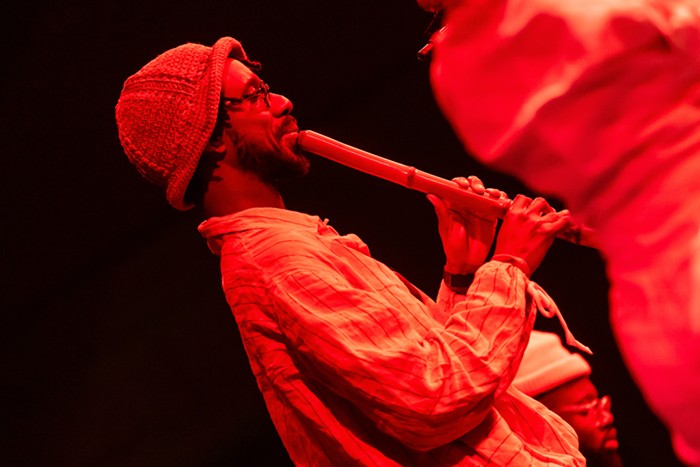
At the end of a recent conversation I had with J. Pinder, we discussed a regional tour that is now under way (The Posse's Off Broadway tour) with Royce the Choice, Dyme Def, GMK, and Eighty4 Fly. J. Pinder: "The tour, which comes to an end in Seattle, is really about giving exposure to a side of Seattle hiphop that's not getting enough attention. The urban side of the scene. The tour is about the urban rappers." Pinder, of course, is a local rapper who has released a mixtape (Backpack Wax) and two EPs (Code Red, Code Red 2.0), and is soon to drop his first album, Careless, on a new label, Fin Records.
Let's explore the meanings of "urban" in the context of Pinder's art and mode. One, Pinder is urban in the sense expressed in his most recent videos: Pinder brooding about love in a modernist apartment on the top floor of a high-rise with a view of a ferry-traversed bay and flowing freeways, Pinder seeing a pretty face on a passing subway, Pinder cruising down a boulevard with beautiful friends. The first video ("Three Words") is set in downtown Seattle, the second is set in New York City ("Go Far"), and the third is set in San Francisco ("Dream Killers"). The first captures urban loneliness; in the second, the urban is portrayed as fleeting encounters with complete strangers; and the third, urban camaraderie and play. Pinder is all about the city, being in the city, falling in and out of love in the city.
In fact, the regional TPOB tour (Bellingham, Pullman, Ellensburg, Yakima) can be seen as a kind of service that Seattle (the big cultural center of the region) provides to small towns and remote college campuses. For those sparsely populated and quiet parts of the Pacific Northwest, hiphop, which has its foundation and reinforcement in the urban, is in another world that can only be heard on the radio, downloaded from the internet, or seen on the television. Pinder, GMK, Dyme Def, Royce the Choice, and Eighty4 Fly (men who've cut their teeth in the hoods and streets of a big city) present these outposts with an opportunity to see and be near the real deal.
The other urban, of course, concerns race. Though Seattle's hiphop community is racially integrated, there is the concern among black rappers that the music is losing touch with its tradition and initial function. Pinder does not say this outright; he is a classy rapper, he makes suggestions. But it's not hard to see how there might be resentment about the state of things, particularly in light of hiphop history. Let's stop and go back to New York City, where Pinder set his video for the melodic and poppy track "Go Far." Hiphop was born here in the '80s because of cuts in music education, general disinvestment in poor neighborhoods by a white-run government, and construction projects that deracinated whole populations. Hiphop was a technology invented to cope with these oppressive conditions. And it worked. It kept thousands of kids out of prison. It became a CNN for the streets. It brought pleasure to the clubs. It became an economy. White Americans left blacks in the city with nothing, and blacks made something out of this nothing, and that something has expanded into a billion-dollar industry. True, hiphop is now for everyone (the meaning of T La Rock's 1984 declaration "It's yours!"), but if you decide to be a part of the culture, you have to appreciate this long history of oppression and struggle.
That said, Pinder is not at all obsessed with blackness; he does not rap so much about race as about life. Pinder is also urban in the sense that he is cosmopolitan. This cosmopolitanism is expressed in the way he and Fin Records, a label that's based in Ballard and houses all kinds of acts (rock, pop, classical), connected and found common ground. "My new album is called Careless because it represents everything I'm thinking about, everything that's happening right now: hiphop, the economy, Occupy Wall Street," says Pinder, whose rhymes are never complicated or rushed or forced, but carefully carved to smoothly conduct his feelings and thoughts. "Careless embodies my one shot at the world. It's my way of doing Marvin Gaye's What's Going On. The album is very musical, very messagey, and very encouraging." I hope this young man goes far.