Before I begin, I must make two things clear. One, the author and critic Matthew Stadler is a deep thinker, a remarkable writer, and a longtime friend. Two, I'm mentioned twice in Stadler's new anthology, Where We Live Now: An Annotated Reader. The book is a curious theoretical defense of urban sprawl in three parts.
It begins with a section of Cities Without Cities: An Interpretation of the Zwischenstadt by the German architect and urban planner Thomas Sieverts. Diana George's excellent translation describes zwischenstadt, literally "in-between city," as "where we live now." Sieverts argues that the dichotomy of center and periphery (downtown and suburbs) is over, that we must now look at cities as clusters of multiple centers, and that sprawl isn't a problem to be fixed. It's just where we live now. Stadler appends this essay with 400 pages of theory, criticism, history, and fiction that help develop this concept. The third part is the running commentary by Stadler in the margins. "The middle ground, the new in-between condition, must be articulated," he writes in the introduction to Where We Live Now. "This shared story... is bracing. It is possible that it could also become liberating."
Stadler's project to reevaluate and theorize sprawl has three levels: a political level (about sprawl's poor and diverse population), a historical level (arguing that Northwest Native Americans basically lived in a pre-European kind of sprawl), and an aesthetic level. "What could make sprawl more beautiful, more enriching, and more human?" Stadler writes. "Better art and writing."
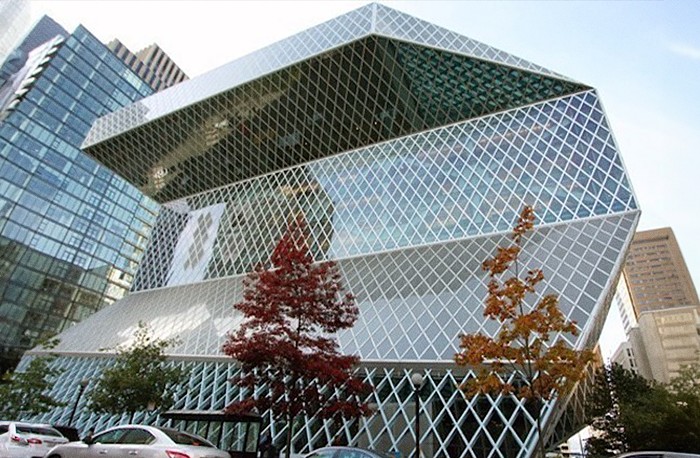
Stadler was not always a defender of sprawl. He had a turn in his path, and it mostly corresponds with his move from Seattle to Portland (a journey he made with a three-year stop in Astoria). To begin to understand the turn, one must read this brilliant passage from the end of Stadler's defining essay on Rem Koolhaas's Seattle Central Library, "An Artificial Heart," published in Nest magazine in 2004:
OMA and the library have kick-started new possibilities by implanting this artificial heart at the center of the city. The heart will be severely tested when its doors are thrown open and people pour through. Can a building oxygenate a population or circulate it sufficiently into the vast compromised flesh of the surrounding blocks? As in many other places, vitality is being driven out of Seattle's core and squeezed into its margins. Downtown has been given over to the colossal drama of money's rise and fall, pushing the mess of urbanity out to fill the exurban strip malls, now teeming with fluorescent box restaurants, nail salons, and taverns. Maybe this artificial heart will pump hard enough to reach those margins and bring some kind of life flooding back across an urban fabric that will otherwise soon be starved of it.
That was Stadler before the turn. At that time, the center was for him still a battleground between the interests of the many and the few. And the library represented a victory for the many in this long and sometimes deadly struggle for what the Marxist geographer David Harvey, borrowing from French philosopher Henri Lefebvre, calls "the rights to city"—the destruction of one type of urban space that privileges capital and the creation of another that links with the needs of "urban inhabitants." The success of the Central Library transformed the center of the city from private to public space, from closed to open, from controlled to creative. The Central Library, the best- designed building in the Pacific Northwest, was made by the people for the people. Stadler played a significant role in its realization—he was on the panel that selected Rem Koolhaas and Josh Ramus's design.
The library defines the importance of the core, the heart of the urban system. It's worth fighting for the heart, because that is where the socially generated wealth is concentrated and controlled by the few. The few push the many to the margins, to the third world, out of Manhattan (which Harvey calls a gated community), on the other side of the wall—always the many must be kept at a distance from the wealth of the few. And the 30-year neoliberal project has structured a kind of globalization that promotes the easy flow of capital but impedes, blocks, erects barriers against the flow of poor humans to the centers of power. But what is history but the movement of people from a bad situation to a better one? Two thousand years ago, because of the spreading Sahara desert, Bantu Africans began migrating from Central Africa to Southern Africa. Today, Bantu go to the centers and suburbs of London or Brussels not for the weather, but for the wealth.
"An Artificial Heart" expressed this mode of politics—the right to the city. His turn to the suburbs, however, expresses another mode of politics. Stadler writes in an annotation in Where We Live Now:
Today, in the United States, those "displaced from [the third world]" find their new homes in sprawl. In Portland, for example, among documented arrivals, five new immigrants move to the city's suburbs for every one that moves into the city; adding the undocumented may well tip the balance even more sharply to the [suburbs]. The city itself is far less dynamic or international than the belt of sprawl around it. What do we refuse when we reject the suburbs?
The main point of the book—which functions as a great introduction to Sieverts, and a number of urban theorists such as Yi-Fu Tuan, Saskia Sassen, and Aaron Betsky—is to give the periphery/sprawl/suburbs/where we live now a new literature, poetry, and history.
The political part of the project emphasizes diversity. This part of the turn I absolutely agree with. If you refuse to see where we live now, you are rejecting its racial and ethnic richness. This is certainly the case with an in-between area like South Seattle and its center, Southcenter Mall. The diversity there is like nothing you'll find in downtown Seattle or Fremont, which is over 80 percent white. And so we have a center that boasts a diversity of architecture—meaning a diverse surface—but a homogenous depth. The opposite is the case with the suburbs of South Seattle: They have a homogenous surface but a diverse depth.
The historical part of Stadler's turn, however, is more difficult to appreciate. He connects the pre-European world of Northwest Natives with the current sprawl culture of flows and decenteredness. Though living off an economy of hunting and foraging, the Natives in this region lived with a density that was urban but without city centers. It was a dense circulation of human souls. Stadler tries to ennoble sprawl by suggesting its origins are in Native, pre-European settlement. (He even equates Native traders traveling in boats up and down rivers with current suburbanites driving their cars up and down highways.) To associate those migrations and modes of subsistence with the urban flows of our day is an imposition on a past society that was radically different from our own.
The main problem, and this problem is even visible in the anthology, is that Western scholarship speaks for much of that part of the region's history. (In the book's Native American/historical section, only one text is by a Native American, Louis Kenoy, and it hardly says enough about the substance of the pre-European experience.) The pre-European form of economy and way of living is not a precursor to the sprawl of the present. It is really, really gone—and we live in the world that brought about its destruction. That is also a part of where we live now.
True, the culturally empty spaces of sprawl present a surface for an artist to project his/her ideas, rather than a packed space of power projecting its ideas on the artist. It is the opposite of the "City Beautiful" movement—the turn-of-the-century project to pour money into fancy buildings that would aesthetically "correct" flawed citizens. (Washington, D.C., is a result of this movement: the anti–strip mall.) Stadler's is a kind of "City Ugly" movement. The empty, smooth surfaces of consumption become the flat surfaces of projection. But that demands that we do all the work. In any creative experience, one wants to get as much as one gives. A situation of exchange produces the richest kind of relationship between what Lefebvre called representational space and represented space: designed space and lived space.
Ultimately, Stadler's current project is to become a stranger kind of poet: a poet of sprawl. We have seen the poet of the country and the poet of the city... but a poet of sprawl? Is that even possible?