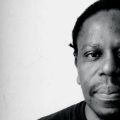
Del the Funky Homosapien Keeping it dreamy.
“Why they call you Del the Funky Homosapien?” asks a puzzled gangsta
on I Wish My Brother George Was Here. “It means a funky human
being,” replies an exasperated Del. Though sonically and genealogically
tied to the NWA school, Del is not a gangsta rapper. Whereas gansta rap
is all about keeping it real, Del is all about keeping it dreamy.
Whereas gansta rap’s realm is the hood, Del’s is the imagination.
Whereas gansta rap is dead serious, Del is creatively silly.
Del the Funky Homosapien’s career begins with his cousin Ice Cube.
Ice Cube, of course, established his career with NWA, the source of
L.A.’s post–World Class Wrecking Crew sound. In the mid ’80s, the
tunes produced by the World Class Wrecking Crew, L.A.’s first major rap
crew and the point of origin for NWA founding members Yella and Dr.
Dre, were very much indebted to New York crews like Whodini and
Run-D.M.C. NWA represented L.A.’s first real break from the East Coast
debt and movement toward a new regional form of hiphop. Because Del was
close to Ice Cube, the sound of his first album, I Wish My Brother
George Was Here, is very much connected to the Funkadelic-heavy
hiphop that branched out from NWA at the opening of the ’90s.
On his second album, No Need for Alarm, Del completely breaks
with L.A.’s Funkedalic program and plugs into the boom-bap pulse that
then dominated the East Coast. It can be argued without difficulty that
No Need for Alarm marks the opening of the Bay Area’s Left Coast
hiphop—from it branches Hieroglyphics and Souls of Mischief.
“Finally, someone let me out of my cage,” raps Del on Gorillaz’s
defining tune, “Clint Eastwood.” After establishing the Left Coast in
the early ’90s, Del made an impressive transition into a form of hiphop
that emerged right after Dan the Automator and Kool Keith released
Dr. Octagonecologyst in 1996. Art hiphop? Post-hiphop? Or
Post-postmodern hiphop? Reanimation hiphop? (Reanimation because it
revived so many dead careers—Prince Paul, MF Doom, Cee-Lo of
Gnarles Barkley.) Whatever one may call it, we all know it has these
distinguishing characteristics: It’s playful, often theatrical, rarely
not ironic, and it has a taste for forgotten cultural junk—cheesy
science-fiction films, low-budget sleaze, Playboy-mansion chic. Del not
only worked with Dan the Automator on the Gorillaz project, the two
also released in 2000 one of the most impressive and ambitious works of
sonic science fiction, Deltron 3030.
On his latest album, Eleventh Hour, Del fully breaks with
post/reanimation hiphop and takes an unexpected journey into the
twilight of New York’s underground hiphop. Def Jux is the album’s
label, and much of Eleventh Hour‘s sound is within the limits of
that label’s program of low-tech boom bap. Del’s latest direction,
however, is not his most productive or creative. He’s not doing
anything that is really new or innovative. All of the wacky science
fiction of Deltron 3030 and Both Sides of the Brain is
gone, and so is the playfulness of Gorillaz.
We are left with a very serious and almost too stark Del who is not
expanding the possibilities of hiphop but trying to save it from
itself, trying to reinforce its core aesthetic values. Sometimes the
rescue mission meets with success, as on the dazzling track featuring
Ladybug Mecca, “I Got You,” the melancholy “Last Hurrah,” and the old-
school “Slam Dunk.” But often Del seems to be making hiphop for no
other reason than to demonstrate to the listener that he is making
underground hiphop, and not the phony, corrupted crap manufactured by
the mainstream. What’s lost in this practical demonstration is the joy
and excitement of making hiphop. Always what one wants to hear is a
hiphop that does things that it’s not used to—a hiphop that is
continually surprising, shocking, breaking, distorting, and contorting
itself.
We may hate a lot of things about the current state of rap, but the
solutions to these grievances should not be located in the
stabilization and reinforcement of its precommercialization traditions.
Rappers like Del must look forward and continue to utilize hiphop as a
tool for new cultural situations, new ways of dreaming.