


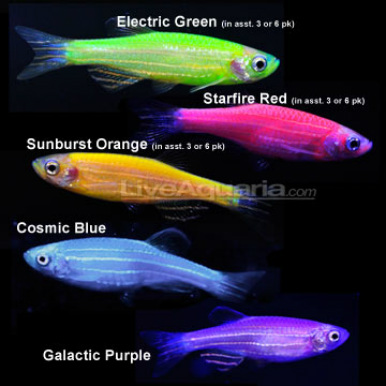
TFW You Can’t Tell Whether a GMO is a GMO: Public debate over the ethics of genetically modified orgnisms (GMOs) tends to focus on biotechnology’s more dramatic applications: think rice with Vitamin A and artificial herbicide resistance, or GloFish, a patented line of flourescent zebrafish for pet stores. In these examples, scientists have transferred genes between distantly related species in order to pass on useful traits. The end result is an organism that carries a diagnosable chunk of foreign DNA in its genome, something even stalwart advocates for the safety and utility of GMOs can admit carries a whiff of “playing god.” But what if instead of targeting genes from different species, you use genetic engineering to create individuals carrying a useful mutation already present in other members of their own species? Now, the end result is an organism that cannot in any way be distinguished from one produced by conventional selective breeding. And more and more frequently, these organisms are being used to solve ethical and environmental problems in agriculture, raising the important question of whether we’re more worried about the process of genetic engineering, or its outcome. Michael White has more over at Pacific Standard.
Moon Cycles Might Cause Earthquakes: Adding to the list of phenomena the phases of the moon are believed to influence, researchers at the University of Tokyo have published research suggesting the moon’s tug on tides can contribute to seismic activity. In the paper, published in Nature Geosciences this month, Satoshi Ide and colleagues report that “very large earthquakes” (including recent shakes in Sumatra, Chile, and Japan) tend to occur at the time local tidal stress is highest—the time the sun and moon align and exert a combined gravitational pull on the earth’s crust. Wired magazine goes into the details, including a quote from UW’s own John Vidale that nicely highlights the uncertainty and messiness of science: “ “Sadly, it may take another hundred years of data to nail down the pattern solidly.”
A Farmer Travels From Uganda to UW to Study Wolves, Does Well: Carol Bogezi grew up on a farm in rural Uganda, channelling an early interest in the nature of her home to a job with the Wildlife Conservation Society. She’s now a Ph.D. student in the College of the Environment of the University of Washington, and is straight-up killing it: on Monday, Seattle’s Bullit Foundation awarded her a $100,000 fellowship to complete her research. Bogezi’s work at UW focuses on the relationship between wolves and ranchers in Washington, and ways to mitigate potential conflicts. In an interview with Oregon Public Broadcasting, Bogezi emphasized the universal nature of human-wildlife conflict. “People perceived wolves as useless or a nuisance. I was like, ‘I would hear exactly that, in just a different language… from a herder in Uganda.’”
Science Event of the Week: Preeminent astronomer, scientist, and TV personality Neil deGrasse Tyson is coming to town next week where he’ll be speaking at the Paramount Theatre on Wednesday, September 21st, at 7:30 PM. Tickets range from $31 to $72, and I imagine you should buy them soon. If you’re interested in being “that guy” during the Q&A session, you might also consider reading up on some of Tyson’s recent tweets about sex.