


The story of the birth of modern art can be told as a fairy
tale—French impressionists marching out of the dark forests of
Barbizon into the sunny countryside of Aix-en-Provence and the
sparkling cafes of Montmartre. By contrast, the story of German art at
the turn of the 20th century is fraught, fractured, and untold: It did
not survive the Holocaust. Even Germans wanted nothing to do with
German art history after that war.
An exhibition at the Frye Art Museum now is nothing short of a major
excavation of artists whose views of what’s modern are messy—and
maybe closer to where we ended up in this pluralistic 21st century than
impressionism, cubism, or any other single “ism.” There hasn’t been an
American survey of these artists in 100 years. Even in their own
country, they’re only now getting a fair showing. The Frye’s exhibition
The Munich Secession and America is not only an aesthetic
adventure, it’s also part of an emotional coming home for artists
exiled from history for reasons that had nothing to do with them.
In this adventure, there are dead ends. The question nags from the
start: Um, was this art forgotten for a reason? This show is a
particularly bold move on the part of the Frye, a laying-on-the-line of
its founding collection, which is from the Munich secession; loans from
European museums are mixed in with collection holdings. Just how good,
important, and interesting is the Frye’s collection when you can really
see it in context? Is it a symbol of progressive, rebellious creativity
or lame, backwater pretensions to greatness?
Germany has suffered from its own inferiority complex for centuries
in art (there’s even a book devoted to the subject, The Germans and
Their Art: A Troublesome Relationship, for sale at the Frye
bookstore). A search for legitimacy in and through art is meritocracy
at its best, concerned with tradition, work, compassion, and hope about
the future.
Here’s what the Munich secessionists thought about those things:
Unlike Gustav Klimt, the great gilder, of the contemporary Vienna
secession, these artists believed in truth telling even if it meant
ugliness. They believed that God’s best qualities were Christlike,
which is to say socialist, which is to say they painted the plight of
the poor. They were starting to get interested in the obscure anterooms
of the emerging field of psychology: dreams, the occult—territory
the surrealists would later dive into. They foretold abstraction but
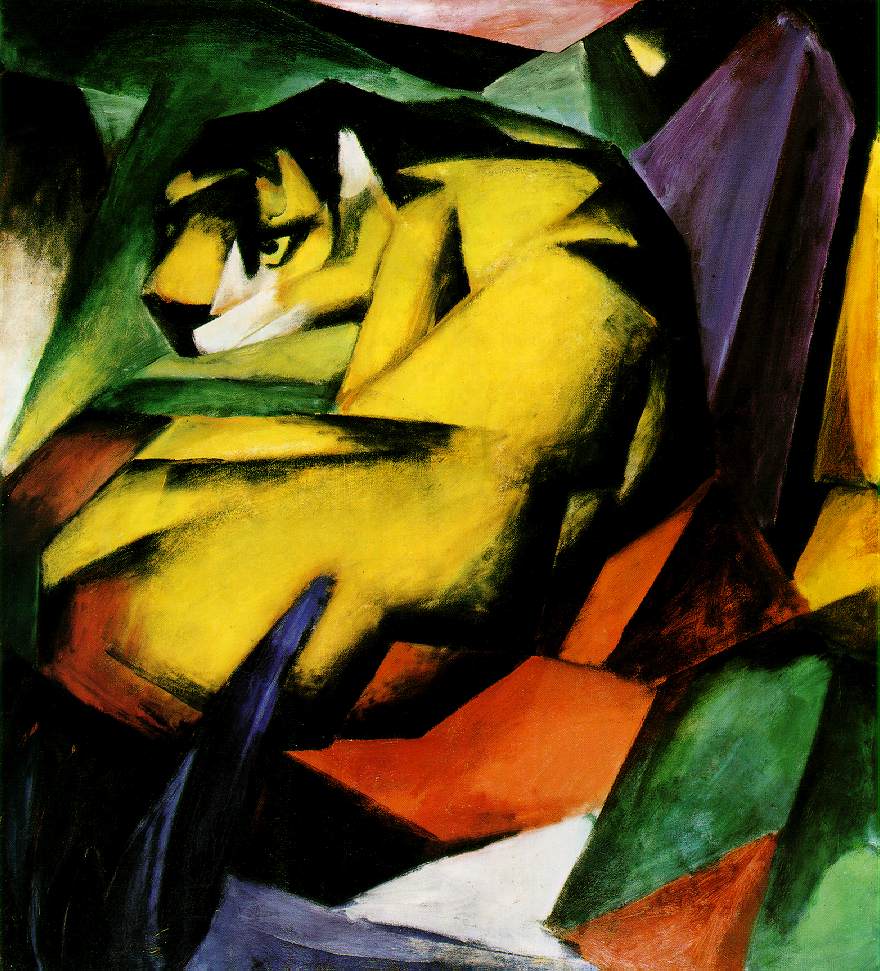
resisted it (the shaded planes of bright color in Hugo von Habermann’s
1911–1917 portrait of a woman bring to mind Tiger from
1912 by Munich-based Blue Rider Franz Marc, which clearly points to cubism and beyond, while von Habermann’s semiconventional portrait points
nowhere in particular). They also laid groundwork for the utopian
integration of decoration, functional objects, and art that happens at
the internationally influential Bauhaus.
Considered in the context of which-way art—forward or
backward?—the Munich secessionists look tame next to, say, the
Italian futurists, who published their fiery manifesto calling for the
“hygiene” of war (they got it, to their ultimate dismay) in 1909, the
same year that the Munich secessionists had their New York debut at the
Metropolitan Museum of Art.
Formed in 1892, the Munich secessionists are credited as the first
of the proto-avant-garde splinter groups. But their revolutionary
spirit is not violent; in fact, it has an administrative tone. Instead
of issuing a manifesto, the Munich secessionists wrote a “memorandum.”
Published in the extensive exhibition catalog, the memo contains three
exclamation points, but is more characterized by the sedate: “We are
prepared to make considerable sacrifices; everyone will do his best and
submit himself to a jury, whose duties will be discharged by the
executive committee serving at the time.”
The secession was formed because the officially sanctioned
exhibitions were growing too large and too domestic: Every Munich
artist was allowed into the game, when the secessionists felt many
deserved the bench. “Elite” is a key word in the memo. Its claim is
that Munich art has fallen behind the world and must catch up.
Although exhibition design doesn’t come up in the memo, the Munich
secessionists were the ones to introduce what’s known as the “modern
hang,” as opposed to the crowded “salon hang.” Their first show, with
breathing room for each work, included a golden geometric frieze, which
the Frye has replicated in its galleries.
In 1909, when the Munich secessionists showed at the Met, a New
York Times reviewer wrote, “Their sole unity of purpose lies in the
avoidance of unity.” It makes sense that in 2009, the Frye, in its
presentation of the show (curated by Jo-Anne Birnie Danzker, director
emerita of the Museum Villa Stuck in Munich) translates that
description into “diversity.” The introductory wall text includes the
word “diversity” twice. It’s an aesthetic and a political word,
describing the collapse of hierarchies in art while also distancing the
German artists from the notion of racial singularity.
Diverse is an understatement—these artists are all over the
place. Munich secessionism is the anti-“ism.” Though this show is an
academic exercise, the paintings couldn’t feel less academic. “We have
witches burned at the stake, female crucifixions, and homoerotic
wrestling,” Frye curator Robin Held whispered excitedly, drunk on
eclecticism, during the press preview led by Birnie Danzker.
And it’s not just subject matter. It’s style, too. Contemporary
critics described the Munich secessionists as “brash” with a “poster
style,” but really that only applies to a few of them, including Franz
von Stuck, with his striking neo-Greek designs. (Tucked away in a
corner of the show is a standout painting by Stuck, of lovers kissing
under a single, textured golden star.) Their subjects appear in so many
guises: as if glimpsed through a clear window; as if scrawled using
food, blood, and shit; as if consciously designed with an eye to
glamour rather than come upon in nature; as if as unadorned as a
close-up view of tree bark.
After the devastation of World War I, some of these artists were
embarrassed by their idealized visions, while others with darker tones
probably felt vindicated. Cartoonish pastoral myths by Max Kuschel and
Ludwig von Hofmann’s brightly colored paradises (one owned by Thomas
Mann while he was writing The Magic Mountain) could not be more
different from the brooding visions of Gabriel Cornelius von Max and
the symbolist austerity of Oskar Zwintscher and Max Slevogt. (An early
dark star, a landscape by Barbizon founder Theodore Rousseau, was
borrowed from the Henry and is in the very small “guests” section of
the show.)
Now that it’s back out in the open, would it be better if the Munich
secession disappeared again? Absolutely not. There’s freshness and
vitality here. Any isolated section in a Leo Putz painting is a
patchwork of colored daubs that could stand alone as an abstraction
(and does, in Sean Scully’s work of the last 30 years). The
lusciousness of paint and whiff of sexual aggression in a Hugo von
Habermann nude is a living link to artists as disparate as Wayne
Thiebaud and Balthus. Adolf Hoelzel’s Dachau marshes melting into
near-total abstraction are both early for the future and primal in
feeling. Flat Jugendstil prints by Peter Behrens represent another
system of art entirely, the Japanese. Wilhelm Trübner’s gaudy
forest heralds the coming of the only native German “ism,”
expressionism.
Pointing to Trübner’s jarring painting during the press
preview, Birnie Danzker said something fascinating: “You’re looking at
works that you think you don’t like, as I have, but they become very
interesting.” This rings true. If it is, the exhibition is doing its
job. 
This article has been updated since its original publication.

Great review, and well researched.
Really nice, Jen. I wish I could be there.
Eh. Just a single closely related example:
LACMA: http://collectionsonline.lacma.org/mweb/…
“In the 1980s, LACMA established the Robert Gore Rifkind Center for German Expressionist Studies. This comprehensive collection includes approximately seven thousand works on paper and a library of more than four thousand volumes, many containing original graphics, which were key to the accomplishments of the Expressionists.”
Get the Rifkind collection books if you can.
And catch up, Jen. Again, your overdramatization (“Rewriting…”) is … ugh.
Eh. Just a single closely related example:
LACMA: http://collectionsonline.lacma.org/mweb/…
“In the 1980s, LACMA established the Robert Gore Rifkind Center for German
Expressionist Studies. This comprehensive collection includes approximately
seven thousand works on paper and a library of more than four thousand
volumes, many containing original graphics, which were key to the
accomplishments of the Expressionists.”
Get the Rifkind collection books if you can.
And catch up, Jen. Again, your overdramatization (“Rewriting…”) is … ugh.
Dvnms: Your comments are always amazing and truly helpful. Can you please be specific about my overdramatization? Expressionism is plenty beloved. The Munich Secession, not so much, unless I’m really missing something. Please to inform?
Such clean lines! Sezessions and gruppes and werkbunds and arbeitsrates proliferate. Artists abandon one, join another, break from one, attempt to destroy another. It’s messy. Secessions themselves become aesthetically biased, making them akin to the academies earlier. They’re commonly described as elitist, commercial, and cosmopolitan. Dealers, looking for trends in other countries (yes, even in France), are sometimes deeply involved in the programming.
Put it this way: Max Liebermann, Wilhelm Leibl, Max Slevogt, Eugen Spiro, Ludwig von Hofmann, Thomas Theodor Heine, Hans Thoma, and Wilhelm Trübner, who are all in this show, are all in the Rifkind collection as well. But that collection is tagged “expressionist”: what to do?!
If you can’t hear the overdramatization of using “Rewriting Art History” to describe a show
that is micro-historical in nature (a single fissure), what to do.
The broader exhibition on the same subject held last year in Munich included American-German artsit Carl Marr who was painting professor at the Munich Academy and later became the director of that international intsitution. This story can not be fully understood without understanding that organization during that time frame. For better or worse, it was in many ways near the core of this transitional period. To learn more about Marr go to the art museum web page http://www.wisconsinart.org
Tom